

Christopher Damman, Associate Professor of Gastroenterology, School of Medicine, University of Washington. Editor-in-Chief of Gut Bites MD.
Turn on the news and it’s easy to feel overwhelmed. Political division. Environmental crises. Artificial intelligence advancing at breakneck speed. Rising rates of obesity, diabetes, anxiety, and other chronic diseases. Many of us have the sense that the world is becoming increasingly fragmented, uncertain, and difficult to understand.
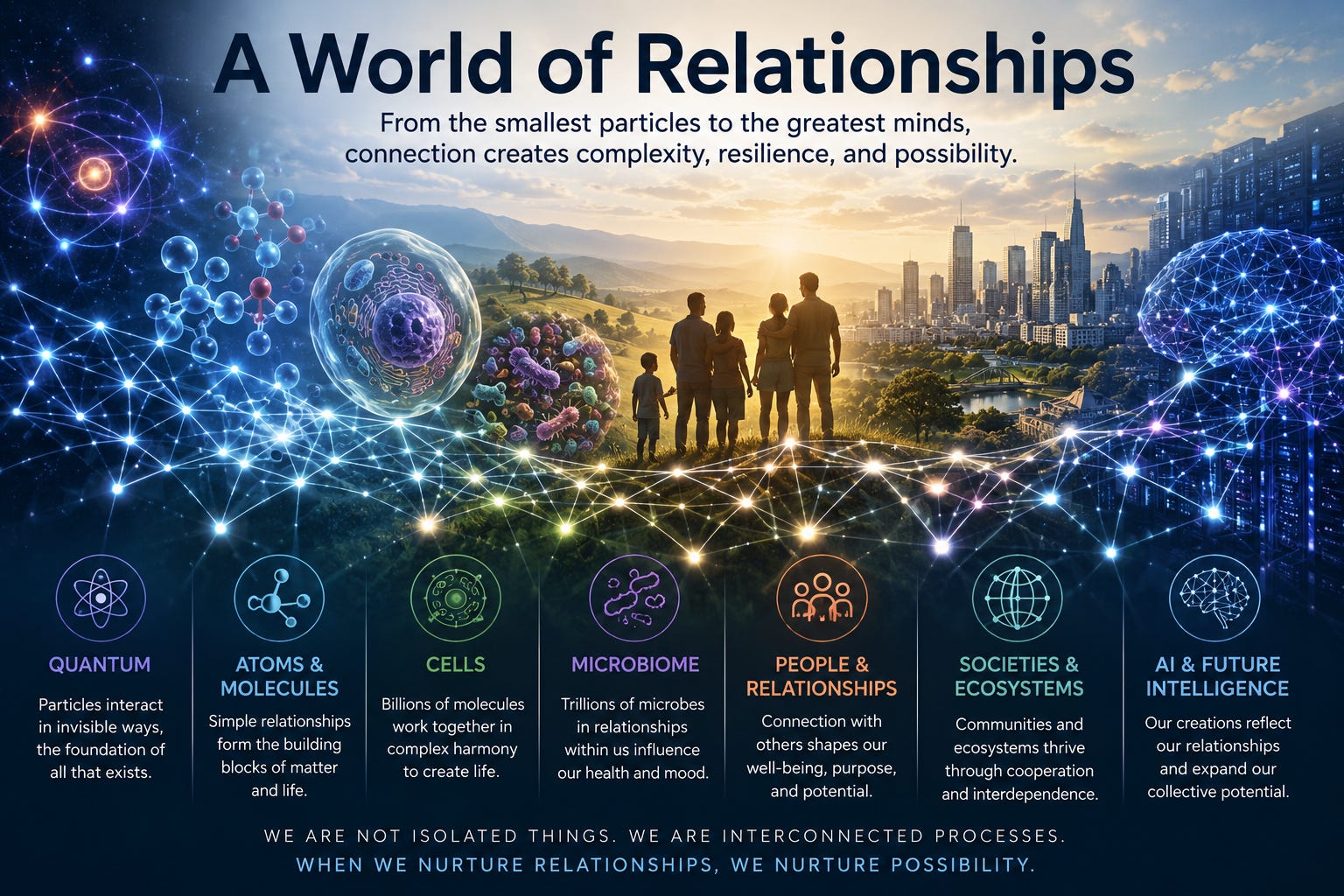
After years of studying nutrition, chronic disease, and the gut microbiome, I’ve become increasingly convinced that many of life’s most important questions are less about isolated parts and more about relationships. In the microbiome, health emerges not from any single microbe, nutrient, or hormone, but from countless interactions among them. The same principle seems to appear throughout biology, ecosystems, human societies, and even the technologies we create.
Viewed through this lens, the story of the universe becomes surprisingly coherent. From the smallest particles to the rise of artificial intelligence, complexity seems to emerge whenever independent things begin interacting in new ways. This perspective doesn’t solve every problem, but it may offer something many of us need right now: a reason for hope.
From Particles to Possibility
At the beginning of the universe, there were no planets, trees, animals, or people. There were only fundamental particles interacting according to simple physical rules. When those particles formed stable relationships, atoms emerged. When atoms formed new relationships, molecules emerged. And when molecules formed increasingly complex relationships, life emerged. The remarkable thing is that the individual components never disappeared. They simply became part of something larger.
Hydrogen and oxygen are not water. Yet when they relate in a particular way, something entirely new appears. The same pattern repeats throughout nature. The whole becomes more than the sum of its parts because relationships create possibilities that isolated components cannot access alone.
Life Is a Relationship Machine
Biology is perhaps the most striking example of this principle. Your body is not a single organism in the traditional sense, but a vast community of trillions of cells working together. Every heartbeat, thought, and breath depends on cooperation among countless components. The same is true of your microbiome. The microbes in your gut are not merely passengers. They form relationships with one another, with your diet, and with your immune system. Through those relationships they produce metabolites that influence metabolism, inflammation, appetite, and even mood.
Health itself may be less about individual parts and more about the quality of relationships among those parts. This helps explain why simple solutions often disappoint. Biology is rarely controlled by a single nutrient, hormone, gene, or microbe. Instead, it emerges from networks of interactions. The healthiest systems are often not the most optimized, but the most balanced.
The Hidden Power of Human Relationships
Humans took this principle to an entirely new level. Language allowed ideas to connect. Trade connected communities. Science connected discoveries across generations. Civilization itself emerged because humans learned to cooperate beyond immediate family groups. No individual built modern society. It emerged from billions of relationships accumulated over generations.
Every meal we eat, every book we read, and every medical treatment we receive represents the combined efforts of countless people we will never meet. The modern world can sometimes make us feel isolated, yet our lives are more interconnected than at any point in history.
Why the World Feels Like It’s Falling Apart
If relationships create complexity, why does the world often feel so divided?
Partly because relationships are powerful enough to create both order and disorder. Social media can connect people across continents, but it can also amplify conflict. Modern agriculture can feed billions of people, yet it has also contributed to environmental degradation and diets increasingly disconnected from the biological systems that shaped human health. Medicine can treat disease more effectively than ever before, yet chronic illnesses continue to rise. Global trade can lift millions from poverty, but it can also spread instability. Artificial intelligence can accelerate discovery while creating uncertainty.
Every major technological advance increases the number and speed of relationships within the system. More relationships create more opportunities, but also more friction. Periods of rapid change often feel chaotic because existing relationships are being reorganized into new patterns.
Nature has gone through similar transitions before. Evolution itself is a story of disruption followed by the emergence of new forms of order.
What About Artificial Intelligence?
Many people fear AI because it appears so different from anything that came before. Yet viewed through a relational lens, AI may represent another step in a familiar process. Human intelligence emerged from relationships among neurons. Science emerged from relationships among minds. The internet emerged from relationships among computers. AI itself emerges from relationships among vast amounts of information.
Whether AI ultimately benefits humanity will depend less on intelligence itself and more on the relationships we build between humans, institutions, technology, and values. The challenge is not simply creating smarter machines, but creating healthier relationships between intelligence and wisdom.
Wisdom in a Relational World
This perspective also changes how we think about wisdom. Wisdom is not simply accumulating facts, but understanding relationships. A wise person recognizes that actions have consequences beyond the present moment. They understand that trust often creates greater value than exploitation and appreciate that short-term gains can sometimes undermine long-term flourishing.
In many ways, wisdom is the ability to see the larger network. The more relationships we can perceive, the more accurately we can navigate reality.
Why Complexity Keeps Emerging
What gives me hope is that throughout the history of the universe, systems built on broader and more productive relationships have repeatedly outperformed those built on isolation. Atoms are more capable than particles alone. Living cells are more capable than molecules alone. Multicellular organisms are more capable than individual cells alone. Civilizations are more capable than isolated individuals alone.
At each step, progress emerged not because competition disappeared, but because cooperation expanded. Systems that successfully integrated more perspectives, more capabilities, and more relationships gained access to possibilities unavailable to their individual parts.
Destructive forces will always exist. Conflict, exploitation, and self-interest are recurring features of nature and human society. Yet these forces are often limited by their narrow focus. They extract value from existing systems but rarely create entirely new forms of value.
Constructive forces operate differently. They connect ideas, people, communities, and resources in ways that allow new possibilities to emerge. In doing so, they often become more resilient, adaptive, and enduring than the forces working against them.
This does not mean progress is inevitable or that every generation moves smoothly forward. History is full of setbacks, collapses, and periods of uncertainty. A forest takes decades to grow, but a wildfire can destroy it in hours. Yet over Earth’s history, forests keep returning.
The same pattern appears throughout nature. Not because destruction disappears, but because systems that successfully build broader, richer relationships gain access to possibilities that simpler systems never had. That pattern is visible in atoms, life, ecosystems, civilizations, science, and perhaps even the future relationship between humans and AI.
Why This Gives Me Hope
Today’s challenges are real. Climate change, political polarization, chronic disease, and AI all present serious risks. Yet they may also reflect something deeper: humanity is participating in one of the most interconnected periods in history.
The same forces creating instability are also creating opportunities for entirely new forms of cooperation, discovery, and understanding. Advances in microbiome science, nutrition, computing, communication, and artificial intelligence are helping us better understand relationships that were previously invisible. Problems once viewed in isolation are increasingly being understood as connected parts of larger systems.
If history teaches us anything, it is that periods of disruption often precede the emergence of new forms of order. The universe has repeatedly transformed apparent chaos into new possibilities. The future is not guaranteed to improve, but neither is it destined to decline.
The next chapter will be shaped by the relationships we choose to build, strengthen, and sustain. That is true for our health, our communities, our technologies, and our planet. The story of complexity is still unfolding, and each of us has the opportunity to contribute to what comes next.
Five Ways to Practice a Relational Perspective
First, invest in relationships before outcomes. Healthy relationships often generate opportunities that cannot be predicted in advance.
Second, focus on contribution rather than control. Complex systems are rarely controlled by any one person, but they can be influenced by many small actions.
Third, think in decades rather than days. The most important effects of our actions often emerge slowly.
Fourth, seek connection across differences. New ideas frequently emerge when previously separate worlds interact.
Fifth, remember that flourishing is contagious. Acts of generosity, curiosity, mentorship, and cooperation often spread through networks in ways we never directly observe.
The Bigger Story
Perhaps the most hopeful realization is this: you do not have to solve the world’s problems alone. No atom created life. No cell created an organism. No individual created civilization. Progress has always emerged through relationships.
Every time we strengthen a family, mentor a student, support a community, improve a technology, prevent disease, restore an ecosystem, or help another person thrive, we contribute to a process much larger than ourselves. The future is not guaranteed. But if history is any guide, the forces that build, connect, teach, heal, and cooperate will continue to create opportunities that destructive forces alone cannot.
In a world that often feels fragmented, that may be the most important truth of all. The future is not built by isolated individuals. It is built through the relationships we create, strengthen, and sustain.
Christopher Damman, Associate Professor of Gastroenterology, School of Medicine, University of Washington. Editor-in-Chief of Gut Bites MD.
Further Reading
Many of the ideas explored in this essay draw inspiration from thinkers working across physics, evolution, complexity science, microbiome research, systems thinking, human cooperation, and artificial intelligence. Readers interested in exploring these themes more deeply may enjoy the following books.
Physics, Emergence, and Complexity
These books explore how order, complexity, and meaning emerge from simpler building blocks and why cooperation and self-organization have repeatedly shaped the history of the universe and life itself.
Sean Carroll, The Big Picture
Physics, emergence, and meaning.John Maynard Smith and Eörs Szathmáry, The Major Transitions in Evolution
How increasing cooperation gave rise to new levels of biological complexity.Stuart Kauffman, At Home in the Universe
Self-organization and the emergence of order.
Human Cooperation and Civilization
These works examine how culture, shared knowledge, and cooperation allowed human societies to accomplish things no individual could achieve alone.
Joseph Henrich, The Secret of Our Success
Culture, cooperation, and cumulative knowledge.Yuval Noah Harari, Sapiens
Human history and the power of shared stories.Robert Wright, Nonzero
Why increasing interconnectedness repeatedly creates new opportunities and forms of complexity.
Networks, Systems, and Innovation
These authors emphasize that creativity, resilience, and innovation often emerge from relationships and interactions rather than from isolated parts.
Steven Johnson, Where Good Ideas Come From
How innovation emerges from networks and connections.Donella H. Meadows, Thinking in Systems
Seeing the world through relationships rather than isolated parts.Fritjof Capra, The Web of Life
Systems biology and the interconnected nature of living systems.
Microbiome and Human Health
These books illustrate how human health depends not only on our own cells, but also on our microbial partners and the ecosystems we inhabit.
Martin J. Blaser, Missing Microbes
The microbiome and modern chronic disease.Justin and Erica Sonnenburg, The Good Gut
Microbiome ecology and the importance of nourishing our microbial partners.
Technology and the Future
These works explore how periods of disruption often accompany the emergence of new technologies, new forms of organization, and new opportunities.
Melanie Mitchell, Artificial Intelligence: A Guide for Thinking Humans
Artificial intelligence and what it means to be human.Carlota Perez, Technological Revolutions and Financial Capital
Why periods of disruption often accompany the emergence of new forms of order.Peter Turchin, End Times
Historical cycles, social instability, and periods of transformation.
Life as an Interconnected System
These books take an even broader view, emphasizing that organisms, societies, and the Earth itself are interconnected systems whose properties emerge through relationships.
James Lovelock, Gaia: A New Look at Life on Earth
Earth as a self-regulating, interconnected system.David Sloan Wilson, This View of Life
Evolution, cooperation, and multilevel selection.
Taken together, these books point toward a common theme that runs throughout this essay: throughout nature and human history, some of the greatest sources of creativity, resilience, and progress have emerged not from isolation, but from connection.
Dr. Damman, I appreciate this essay on thinking both broadly and deeply about the world we live in. Thanks for sharing this perspective. I look forward to reading some of the books that you have suggested.
I enjoy your posts.
Kari Einset
Spokane, WA.
Chris, I found your essay “A World of Relationships” particularly thought-provoking, because I share much of your view that reality may be better understood through relationships and interconnectedness rather than through isolated things.
I am a friend of your mother, Katie, and she and I have enjoyed many conversations about some of these larger questions. In my own thinking, the key word I keep returning to is consciousness. I wonder whether consciousness might be more than simply one product of interconnected biological systems—whether it could somehow be part of the deeper connectivity underlying our experience of reality.
This is what has drawn me particularly to the Penrose-Hameroff's Orch-OR hypothesis and, more broadly, to the question of whether consciousness may have a more fundamental relationship to the physical universe than conventional neuroscience presently assumes.
Your emphasis on relationships seems to approach some of these questions from a different and very interesting direction. I would very much enjoy exchanging thoughts with you sometime.