

Christopher Damman, Associate Professor of Gastroenterology, School of Medicine, University of Washington. Editor-in-Chief of Gut Bites MD.
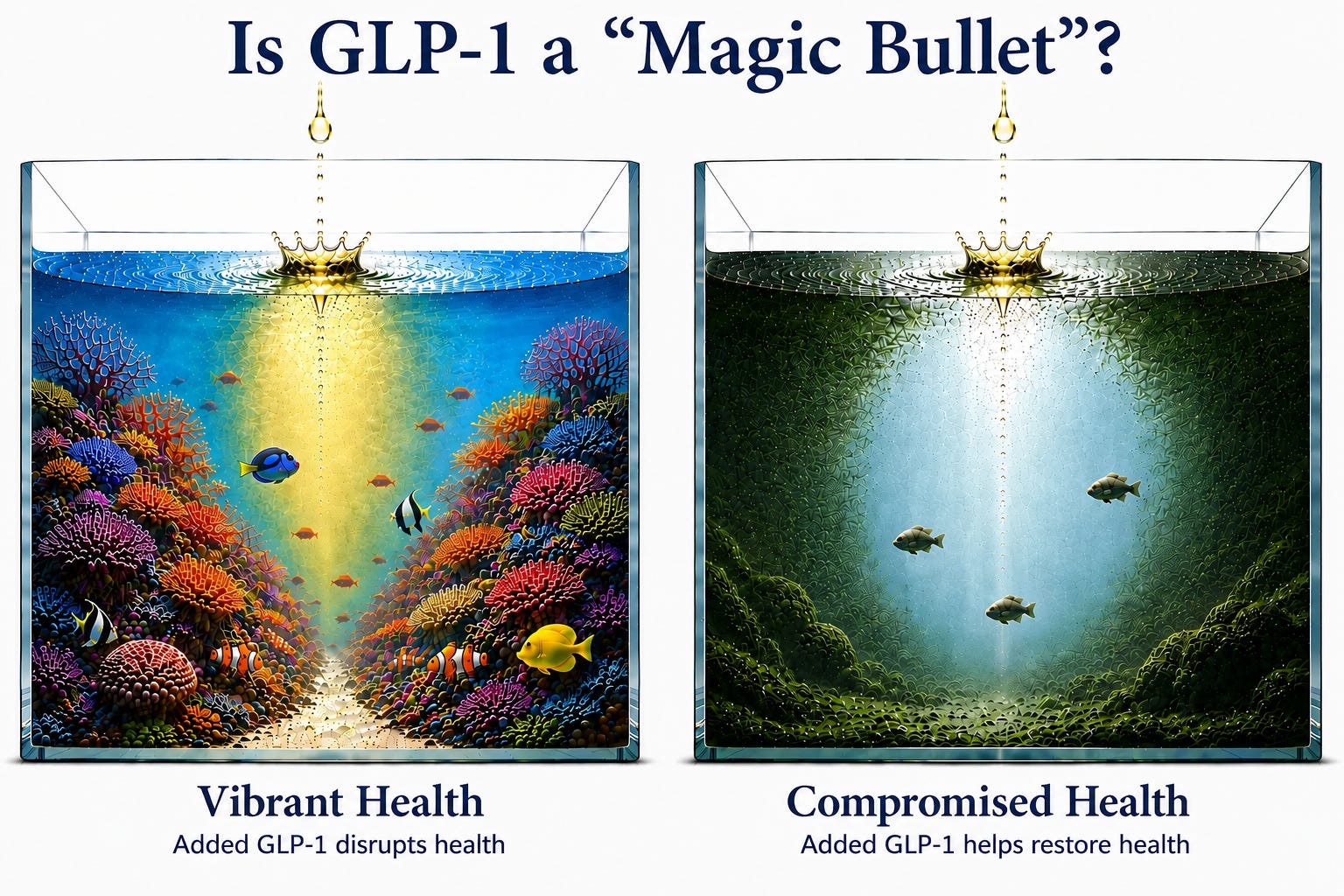
Imagine two fish tanks. One is a vibrant coral reef with clear water, diverse life, and a system that largely regulates itself. Fish move easily, feed naturally, and exist in a stable environment where balance is maintained by the ecosystem itself. The other tank is overgrown with algae. The water is cloudy, oxygen is low, and the fish are sluggish. They struggle to see, to feed, and to function in a system that is no longer supporting them.
Now add a small amount of chlorine to each tank. In the algae-filled tank, the effect feels almost restorative. The water clears, the fish begin to move more freely, and they can “breathe” and feed again. Function returns, and the change feels dramatic. In the healthy reef tank, the exact same intervention is disruptive. Coral bleaches, fish become stressed, and the system begins to break down. The difference is not the chlorine. It is the condition of the system it is being added to.
Why GLP-1 Feels Like a Panacea
GLP-1 medications feel powerful because they act on fundamental biology. They enhance satiety signaling, slow gastric emptying, and improve aspects of metabolic regulation that are often dysregulated in modern life. In a setting shaped by ultra-processed foods, sedentary routines, chronic stress, and disrupted sleep, these effects can feel transformative.
Appetite decreases, weight drops, and people often find it easier to move, think clearly, and engage with daily life. What is happening in many cases is not the creation of a new system, but the partial restoration of a strained one. The drug helps clear some of the “algae,” allowing underlying physiology to function more effectively. The improvement feels dramatic because the starting point was so far from optimal.
The Role of Baseline Health
If we shift the baseline, the picture changes. In a setting where people eat mostly whole foods, move regularly as part of daily life, sleep consistently, and maintain strong social and environmental connections, the system is already closer to balance. Appetite regulation, energy use, and metabolic signaling are functioning within a healthier range.
In that context, adding a supraphysiologic GLP-1 signal is less likely to feel like a solution and more likely to feel like an intrusion. The same mechanisms that provide benefit in a dysregulated system can manifest as side effects when the system is already working well. Nausea, vomiting, constipation, diarrhea, delayed gastric emptying, muscle loss, and nutrient gaps become more prominent. The intervention stands out because there is less dysfunction to offset.
Relative Health vs. True Health
This highlights an important distinction between relative and true health. GLP-1 medications can move someone from a more impaired state to a less impaired one, and that shift can be meaningful and clinically valuable. But it is still improvement within the context of an underlying system that may remain suboptimal.
Feeling better after an intervention does not necessarily mean the system is fully restored. It often means that one constraint has been reduced. The clarity that follows can make it easier to recognize how compromised the baseline had been. The contrast is what creates the sense of a “panacea.”
From Clearing the Water to Building the Reef
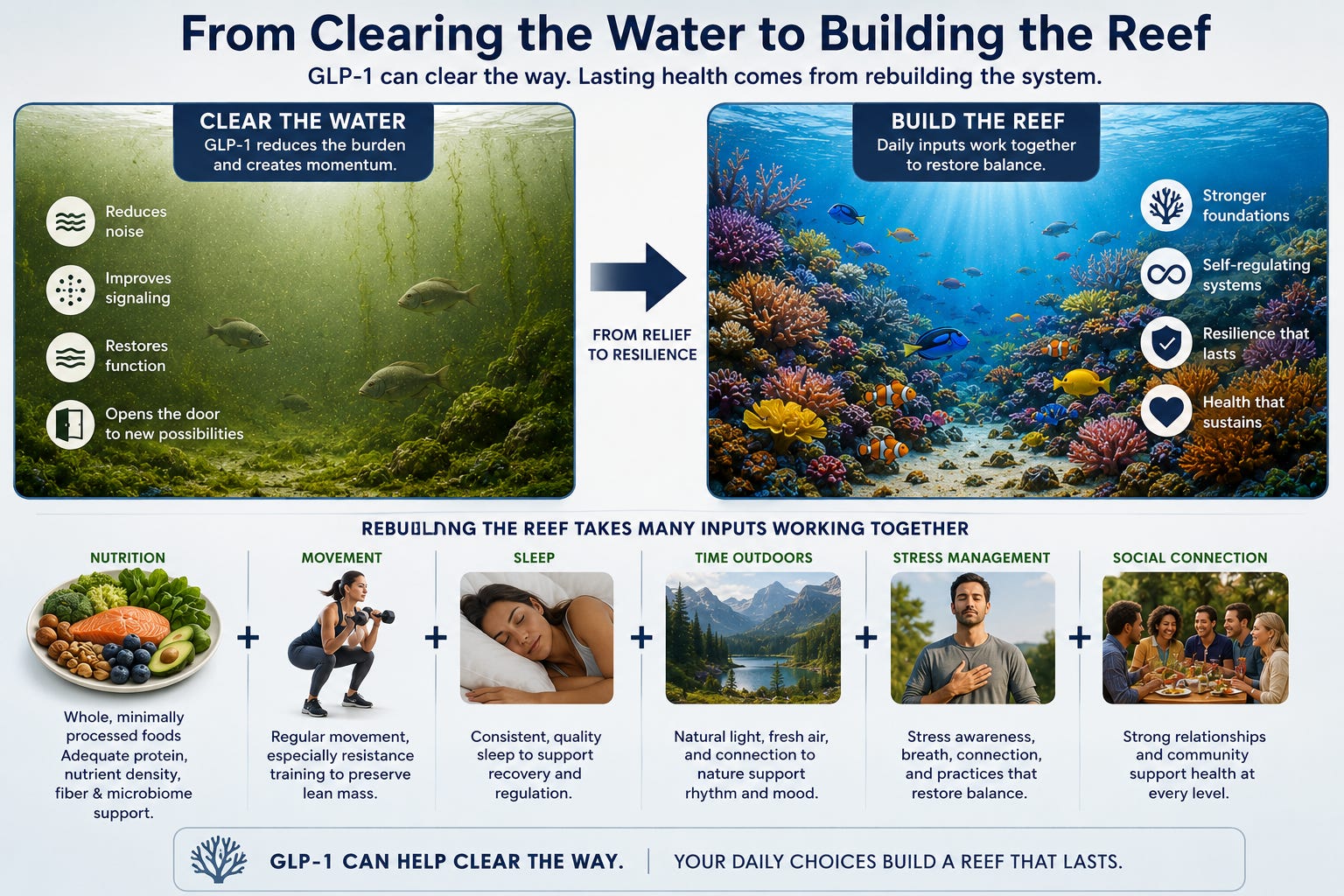
GLP-1 medications have an important role. They can reduce friction, create momentum, and help people re-engage with behaviors that support health. For many, they open a door that had previously felt closed. But they are best understood as part of a broader process rather than the endpoint.
A more durable solution looks like rebuilding the reef rather than continually correcting the water. That includes dietary patterns centered on whole and minimally processed foods, adequate protein and nutrient density, and fiber and microbiome-supporting compounds. It includes regular movement, especially resistance training to preserve lean mass, as well as consistent sleep, time outdoors, and attention to stress. These inputs do not act as a single lever. They work together to restore system-level balance.
The Takeaway
GLP-1 can help clear the water in a system that has become overwhelmed. That benefit is real and, for many, meaningful. But the larger goal is to create an environment where the system can maintain clarity independently.
The opportunity is not just to feel better within a compromised system, but to build one that does not require constant correction in the first place. That shift, from intervention to prevention, is where the most durable improvements in health are likely to come from.
Christopher Damman, Associate Professor of Gastroenterology, School of Medicine, University of Washington. Editor-in-Chief of Gut Bites MD.
Absolutely awesome graphic.....You have nailed the concept folks need to HEAL themselves. We are faced with a plethora of medications, possibly exposed to many hormones via our drinking water. Our challenge is where to start to heal versus medicate. Thank you for this amazing graphic & concept.