


Christopher Damman, Associate Professor of Gastroenterology, School of Medicine, University of Washington. Editor-in-Chief of Gut Bites MD.
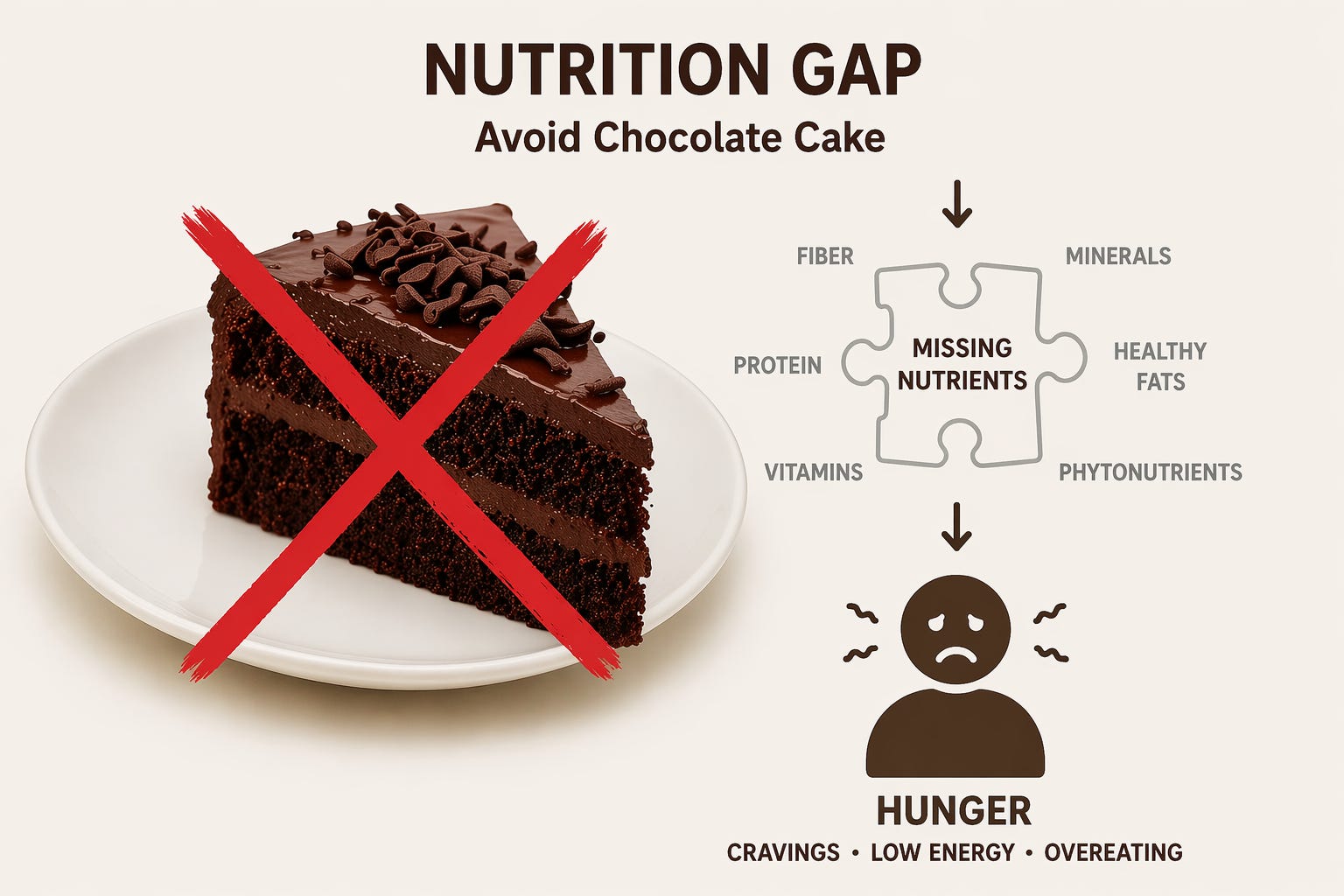
If you’ve ever felt hungry soon after eating, the issue may not be how much you ate, but what was missing from it. For years, nutrition advice has focused on what to remove. Cut carbs, avoid fat, reduce calories, eliminate sugar. While each of these ideas contains some truth, they share a common limitation. They frame health as a process of subtraction rather than balance. But what if the bigger issue is not just what we are eating too much of, but what we are no longer getting enough of?
Modern diets are not only high in certain nutrients. They are also depleted of others. Highly processed foods tend to concentrate refined carbohydrates, sodium, and certain fats while stripping away fiber, potassium, and plant-derived compounds like polyphenols that normally travel with them. This creates what you might think of as a nutrition gap, not just excess, but absence. And those relationships matter, because physiology responds to how nutrients interact within a meal, not just to individual components in isolation.
Why Restriction Often Fails
Avoidance-based approaches can unintentionally widen the very gap they are trying to close. When we focus only on removing foods, the diet may become lighter, but it does not become more complete. What is missing remains missing and our cravings grow bigger.
Biologically, that gap matters. When fiber, protein, potassium, and phytonutrients are underrepresented, satiety signaling is weaker and metabolic responses are less stable. Hunger does not disappear. It often returns sooner and stronger.
In this way, restriction can amplify the cycle of craving and overeating, not resolve it.
Reframing the Question
A more effective approach is to shift the question. Instead of asking what to remove, we can ask what to add back to restore balance. This is not about abandoning the foods you enjoy, but about pairing them with foods that complement what is missing.
When balance improves, something else changes as well. Meals tend to satisfy more. Hunger stabilizes. Cravings often diminish, not because of willpower, but because the underlying nutritional gaps are being filled.
Everyday Examples of Balance
This approach can be applied in simple, practical ways. Potato chips with a yogurt-based dip. A hot dog with turkey chili. Pizza with a fiber-rich salad. Chocolate with almonds. Cake with berries.
Each pairing adds back something that is lacking in the original food, improving the overall nutritional balance of the meal or snack. Importantly, these combinations also tend to be more satisfying. By adding protein, fiber, and potassium-rich foods, they support fullness and sustained energy, which can naturally help you reduce portion size and the urge to keep eating or to snack again soon after.
A Closer Look: Cake & Berries
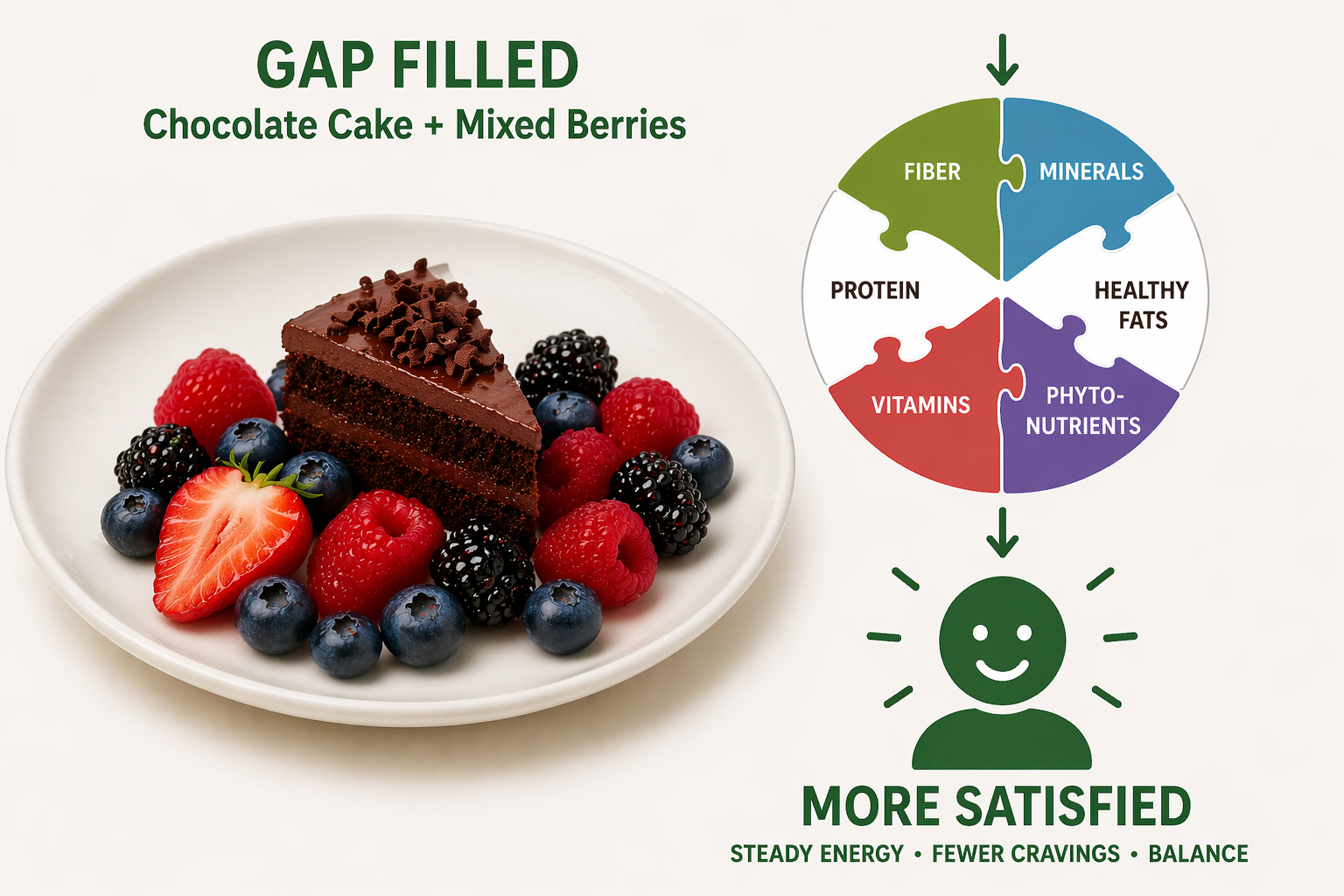
Consider chocolate cake on its own. It is energy dense and high in refined carbohydrate and fat, while providing very little fiber or micronutrient density. This creates imbalance across key nutrient relationships such as carbohydrate to fiber and calories to weight. It is also easy to over consume because it delivers energy without strongly engaging satiety pathways.
Reducing the portion of cake and adding a generous serving of mixed berries lowers simple carbohydrates and saturated fats while adding fiber, micronutrients, and a wide range of healthy plant compounds. Fiber, and plant compounds help slow digestion and enhance gut–brain signaling pathways that regulate fullness.
This helps rebalance key nutrient ratios and improve satiety.
The result is not a perfect food, but a more complete and satisfying one. You are more likely to feel full sooner and stay full longer, reducing both portion size and the likelihood of reaching for more food shortly after.
Measuring Balance
Balance can be difficult to see, but it can be measured. The Nutrient Consume Score evaluates how well key nutrient ratios are aligned within a food, meal, or dietary pattern, incorporating relationships such as carbohydrate to fiber, saturated to unsaturated fat, sodium to potassium, and calories to weight.

Foods that are imbalanced on their own often improve when paired thoughtfully, and those improvements are reflected in higher scores. This provides a practical way to connect food choices with both nutrient quality and lived experience, helping remove guesswork and guide better decisions over time.
Making It Practical
Understanding balance is one thing. Applying it consistently is another. Tools that provide real-time feedback can help bridge that gap.
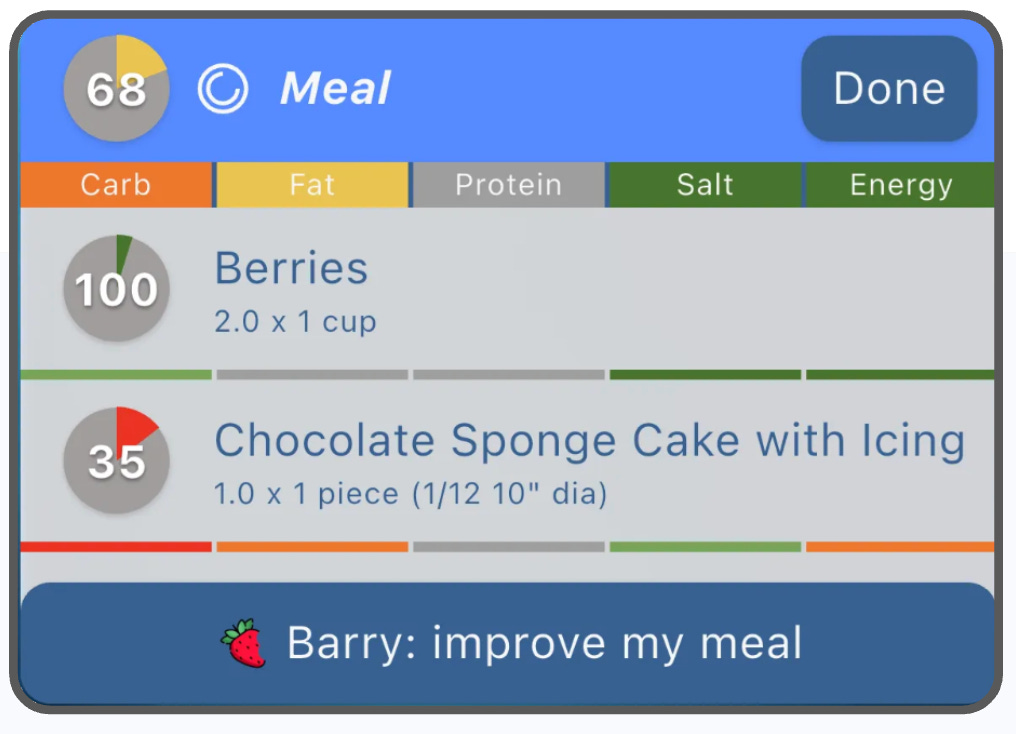
Smart Bites allows you to scan foods, score meals, and track how combinations influence overall balance. Barry, the in-app assistant, suggests complementary additions that can improve what you are already eating.
Instead of guessing, you can see in real time how small additions change the overall balance of a meal. This shifts the experience from restriction to optimization, helping you build meals that are both more balanced and more satisfying.
The Takeaway
Nutrition often gravitates toward extremes because they are easy to communicate, but biology tends to favor balance. Health is not built by removing every imperfect food from the diet. It is built by consistently restoring what is missing.
When balance improves, satisfaction tends to follow. Hunger stabilizes. Cravings diminish. And the path forward becomes both more effective and more sustainable.
In that sense, you really can have your cake and eat it too. You just might find you are more satisfied when you have your berries with it.
Christopher Damman, Associate Professor of Gastroenterology, School of Medicine, University of Washington. Editor-in-Chief of Gut Bites MD.
I love these excellent nutrition posts. I read them every time they appear on Substack. Such wonderful knowledge for those of us who are trying to rebuild our microbiome. Thank you for taking the time to educate us.
Love this balanced approach to nutrition, Chris. Very refreshing in today's politicised age of nutritional science.